Kash Patel LEAVES ‘The View’ in CHAOS—One Sentence Changed Everything!

The Stage Is Set for a Battle
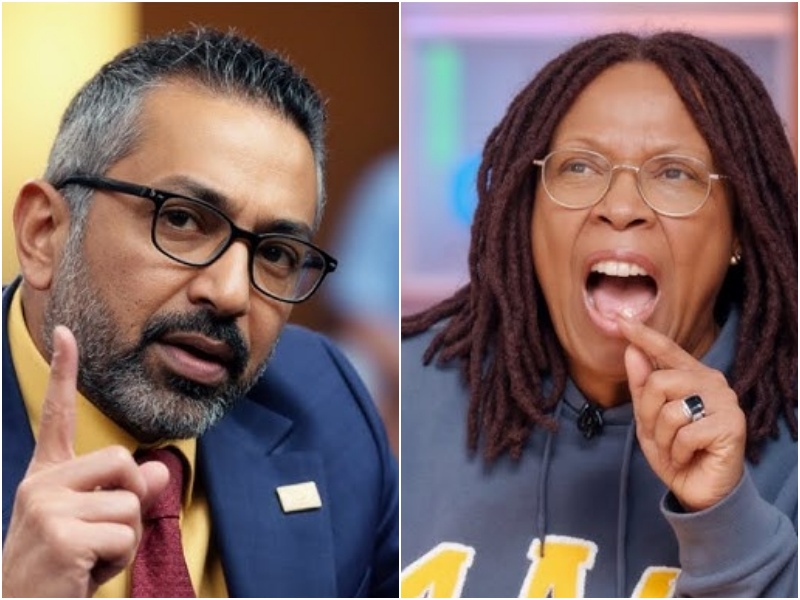
Atlanta, Georgia – The air inside The View’s studio was thick, charged with the anticipation of something far bigger than a routine talk show. Studio lights gleamed, hosts took their places like seasoned swordsmen, ready for a battle of wits. In the control room, the director whispered, “Let him expose himself.”
Cash Patel stepped out—not with the hesitance of a guest, but with the cold confidence of someone well-versed in the eye of the storm. A deep blue suit, a plain tie, understated yet commanding. He nodded at the audience, his gaze sweeping the rows with unnerving calm. A few scattered claps broke the silence, mingling with skeptical murmurs.
At the host table, Whoopi Goldberg was calm but sharp. Joy Behar flashed a smile as cutting as a blade. Sunny Hostin sat taut as a bowstring, ready to strike. No one on the panel suspected they would soon lose control of their own narrative on the very stage they’d mastered for years.
The Opening Salvo: Not an Interview, but a Trial
Whoopi opened the show with her signature warmth, but her words were pointed:
“Welcome to The View. Today is a conversation I know no one wants to miss. Please give a round of applause for our special guest, FBI Director, former National Security Adviser, and author of ‘Government Gangsters’—Mr. Cash Patel.”
The audience clapped, rhythmic but restrained. Patel offered the faintest of smiles, eyes never leaving the host table. His voice was low, steady, unshaken:
“Thank you for having me. I’m ready for a candid conversation today.”
There was no hint of deference, no veneer of humility. Patel hadn’t come as a guest—he came as someone who’d already read the script and was ready to rewrite it.
Whoopi pressed on, her tone turning serious:
“Cash, you’ve stirred controversy by talking about prosecuting journalists for what you call misinformation in elections. Do you really think putting reporters on trial will solve the problem, or is this a way to silence dissenting voices?”
The question was like an opening shot. The room held its breath. Patel leaned forward, eyes locked on Whoopi:
“Prosecution isn’t about silencing voices. It’s about protecting the truth. When a media outlet deliberately spreads false information, undermining trust in elections or manipulating voters, that’s no longer journalism—it’s harm. My role is to ensure the law is enforced, no matter who’s involved.”
Sunny Hostin, a lawyer, cut in sharply:
“But Mr. Patel, who decides what’s false? You, as FBI Director? That sounds like a step toward controlling the press, and the First Amendment doesn’t agree with that.”
Patel nodded, not dodging:
“I agree. The First Amendment is foundational, but it doesn’t protect fraud. If a media outlet fabricates evidence to smear someone or cause chaos, that’s criminal, not free speech. I’m talking about illegal actions, not opinions or articles someone doesn’t like.”
A few scattered claps broke the tension. Joy Behar, unable to hold back, smirked:
“You talk about the law, but it sounds like you want to turn the FBI into a media patrol, jailing anyone who dares criticize the administration. What kind of justice is that?”
Patel turned to Joy, gaze calm but sharp as a blade:
“Miss Behar, I’m not targeting critics. Criticism is the core of democracy. But when someone uses media power to fabricate, manipulate, or undermine elections, they must be held accountable. Justice doesn’t pick sides, and neither do I.”
The murmurs in the crowd grew louder—some nodding, others shaking their heads. Anna Navarro jumped in:
“You sound reasonable, but how do we trust you’ll be impartial? You’re Trump’s guy. You worked for Truth Social. Will your FBI go after anti-Trump outlets first?”
Patel gave a faint smile, not to appease, but to hold his rhythm:
“The FBI isn’t my tool or anyone’s. Every prosecution decision will be based on evidence, through legal processes and reviewed by courts. I don’t have an enemy’s list, only the law.”

Alyssa Farah Griffin, the only host who’d worked in the Trump administration, spoke up:
“Cash, I get your point about accountability, but the phrase ‘prosecuting journalists’ scares people. Don’t you think your rhetoric is hurting trust in the FBI?”
Patel looked at Alyssa, his voice low but compelling:
“I understand that fear and I don’t want to cause panic. But trust in the FBI isn’t built by dodging issues. Genuine journalism, those digging for truth, is a national asset. But those abusing power to deceive aren’t.”
A sudden burst of applause erupted, stronger than expected. The camera panned over the crowd, but the director signaled not to zoom in.
Sunny, sensing the shift, pressed on:
“You talk about truth, but you once backed ideas like Italygate. How do we trust you as a guardian of truth?”
Patel responded unruffled:
“Miss Hostin, I’m not here to debate old allegations. I’m here to talk accountability. If there’s evidence a media outlet breaks the law, I’ll act. No evidence, no prosecution. Clear and transparent.”
The applause rang out again, this time louder, stronger, and unrelenting. A few audience members even stood. From the back rows, someone shouted, “Keep going, Cash!” Joy Behar faltered, shuffling her note cards, her eyes darting across the room with visible unease. Beside her, Whoopi Goldberg leaned forward as if to intervene, but the lights and applause made it clear—the audience was leaning toward Cash Patel.
When the Guest Takes the Reins
Patel didn’t need to seize the moment. He just sat there, calm as if in his own office, hands resting lightly on the armrests, gaze scanning each host like a chess player, quietly waiting for an opponent’s misstep. The hosts whispered among themselves, their faces no longer holding their usual confidence. They’d expected a stumble on the “prosecuting media” topic, but Patel not only didn’t falter—he tilted the room in his favor.
Alyssa Farah Griffin, steady but incisive, asked:
“Cash, you were a close adviser to President Trump, behind the Nunes memo and later involved with Truth Social. How can the public trust that as FBI Director, you’ll act independently and not just carry out Trump’s will?”
Patel leaned in, eyes focused, voice low but forceful:
“Miss Griffin, I don’t deny my ties to President Trump. But the FBI isn’t a tool for any individual, including him. My job is to protect national security and serve the American people, not a party or a person.”
Joy Behar, not missing a beat, cut in, voice dripping with sarcasm:
“Oh, really? You wrote a children’s book calling Trump ‘King Donald.’ That’s blind loyalty, not serving the country. You expect us to believe you’re impartial?”
Patel smiled, not to defuse, but to hold his ground:
“Behar, the children’s book was a fun story, not policy. But if we’re talking loyalty, I’m loyal to the Constitution first. I worked with Trump because I believe in his agenda—protecting American interests, fighting corruption. That doesn’t make me any less independent.”
The audience stirred, some clapping, others shaking their heads. Anna Navarro, sharp:
“But Mr. Patel, you advised Trump Media, a company amplifying Trump’s message. How does your FBI not become an extension of Truth Social, targeting political opponents?”
Patel, gaze unwavering:
“Miss Navarro, my past doesn’t dictate the FBI’s future. I left Trump Media to focus on national security. The FBI operates on evidence and law, not tweets or posts. If a political opponent breaks the law, they’ll be investigated regardless of who they support.”
Applause erupted louder than before, with some audience members standing.
The Accusations Intensify—But So Does the Applause
Sunny Hostin pressed:
“You talk a good game, but you once called FBI officials gangsters for investigating Trump. That’s not defending the law, that’s defending Trump. Will you apologize for those words?”
Patel, steady:
“Miss Hostin, I stand by every word. When some FBI officials abuse power to target a presidential candidate without solid evidence, that’s misconduct. I’m not defending Trump because he’s Trump. I’m defending every American’s right to fair treatment under the law.”
A louder wave of applause, mixed with cheers. The camera panned over nodding faces. Whoopi, seeing the audience tilt, tried to regain control:
“Cash, I hear you on fairness, but don’t you think your close ties to Trump make people question your motives? How do you convince Trump’s critics that your FBI is neutral?”
Patel, compelling:
“Miss Goldberg, I’m not here to make everyone like me. I’m here to do the right thing. Neutrality doesn’t mean sitting on the sidelines. It means putting the law above all. If I investigate a case, there’s no Trump friend or Trump enemies, only truth and evidence.”
Applause, longer now, some shouting, “That’s right!” Joy, visibly irritated, cut in:
“But you called Trump’s opponents the deep state. You’re dividing the country, not uniting it.”
Patel, unchanged:
“Miss Behar, I call the deep state those who abuse power to manipulate the system, no matter who they oppose. Unity doesn’t mean agreeing with everyone. It means respecting the truth together. And I won’t stop seeking the truth, even if it makes someone uncomfortable.”
Anna Navarro, quickly:
“So you’d investigate Trump if there’s evidence of wrongdoing, or just his opponents?”
Patel, instantly:
“Miss Navarro, if there’s evidence, anyone—from the president to a civilian—will be investigated. The law has no exceptions.”
The Tension Boils Over
Anna Navarro, sharp as ever:
“You signed books with the slogan WWG1WGA tied to QAnon and attended events like the Reawaken America Tour where conspiracy theories are celebrated. How can Americans trust an FBI director linked to such extremist groups?”
Patel, unshaken:
“Miss Navarro, I don’t control how others interpret my actions. WWG1WGA was a phrase I signed at a fan’s request, not a political statement. I attend many events to listen to people from all perspectives because that’s how you understand issues. My role at the FBI is based on truth and evidence, not rumors or labels.”
Sunny Hostin pressed:
“You talk about evidence, but you once backed Italygate, a conspiracy theory about the 2020 election. As FBI director, how do you justify being linked to ideas your own agency has debunked?”
Patel, gaze unflinching:
“I never endorsed Italygate or any conspiracy theory. I ask questions like any lawyer would when there’s suspicious information, but at the FBI, we don’t chase theories. We chase facts. If there’s no evidence, I don’t pursue it. That’s how I operate.”
The applause was louder, a few cheers. An audience member shouted, “Let him explain!”
Joy Behar, voice dripping with sarcasm:
“You sound good, but showing up at those places was a choice. You chose to stand with people who call the FBI the enemy, and now you’re leading it. That’s hypocrisy, Cash.”
Patel, steady:
“Miss Behar, I don’t pick sides to please anyone. I choose dialogue to understand issues. If the FBI wants to protect people, we need to know what they think, even if it’s hard to hear. I’m not here to be liked. I’m here to do what’s right.”
The Studio Turns
Alyssa Farah Griffin, balanced:
“Cash, I get that you want to listen, but any connection to QAnon, even indirect, erodes trust in the FBI. What will you do to prove you’re not influenced by those groups?”
Patel, eyes locked on Alyssa, voice resonant:
“Griffin, trust doesn’t come from slogans, but from actions. Under my leadership, the FBI will investigate every threat from any group based on evidence, not feelings, not speculation. I carry no loyalty to any individual or movement. My only loyalty is to the law and the American people.”
The response was like a blow. The room ignited. Applause thundered. Many leapt from their seats, cheering. A voice from the back rang out, “Nailed it, Cash!”
Social Media Erupts
Within hours, social media was ablaze:
“I don’t support Trump, but Patel’s right—the media can’t play God with justice.”
— @realistmom, Twitter
“He’s a danger. Masking political ambition with fancy words.”
— @bluewave2025, Facebook
“Never seen anyone make The View back down like that. #cashontheview”
— @patelwarrior, TikTok
On Reddit and political forums, the debate raged. Supporters called Patel a warrior confronting a biased media machine. Critics branded him a populist, warning of the politicization of the FBI. Even detractors admitted: Patel turned The View into his stage, making the hosts, from Whoopi to Sunny, mere spectators.
IX. Fallout and Lessons
The press pounced:
“Patel Turns The View into a Battlefield. Audience Sides With Him.”
“FBI Director Shocks With Dangerous Message.”
Yet all agreed: Patel’s words reignited a national debate about the media’s role, official power, and the people’s voice.
The View’s official account posted a brief statement:
“Thank you to Cash Patel for a lively discussion.”
But it was drowned out by thousands of comments—praise for Patel, criticism for the hosts.
An insider revealed Joy Behar left the studio visibly irritated, muttering, “He was too slick.” Sunny Hostin declined post-show interviews. Whoopi admitted to a colleague, “We underestimated him.”
Patel, meanwhile, chose silence—no interviews, no posts, just a return to work. Paradoxically, that silence amplified his message.
The Aftermath: A Lesson for America
This was not just a TV moment. It was a sign of the times: where truth, preparation, and courage can shake an entire system.
“From now on, every time I speak, I’ll remember: Don’t just talk, bring the receipts. #patelenergy”
— @officelead, LinkedIn
“If the truth makes someone uncomfortable, ask: Are they afraid of truth or of losing power?”
— @truthmatters, Twitter
The lesson: Don’t let fear of being labeled stop you from questioning. Dare to face, to listen, to speak truth. That’s the only way to protect your own voice.
The Lights Dim, But the Echo Remains
As the studio lights faded, Cash Patel’s words lingered. Not because he was flawless, but because he dared to stand, face a hostile room, and say what many felt but didn’t dare voice.
He didn’t come to be interviewed—he came to change the game. And he did.