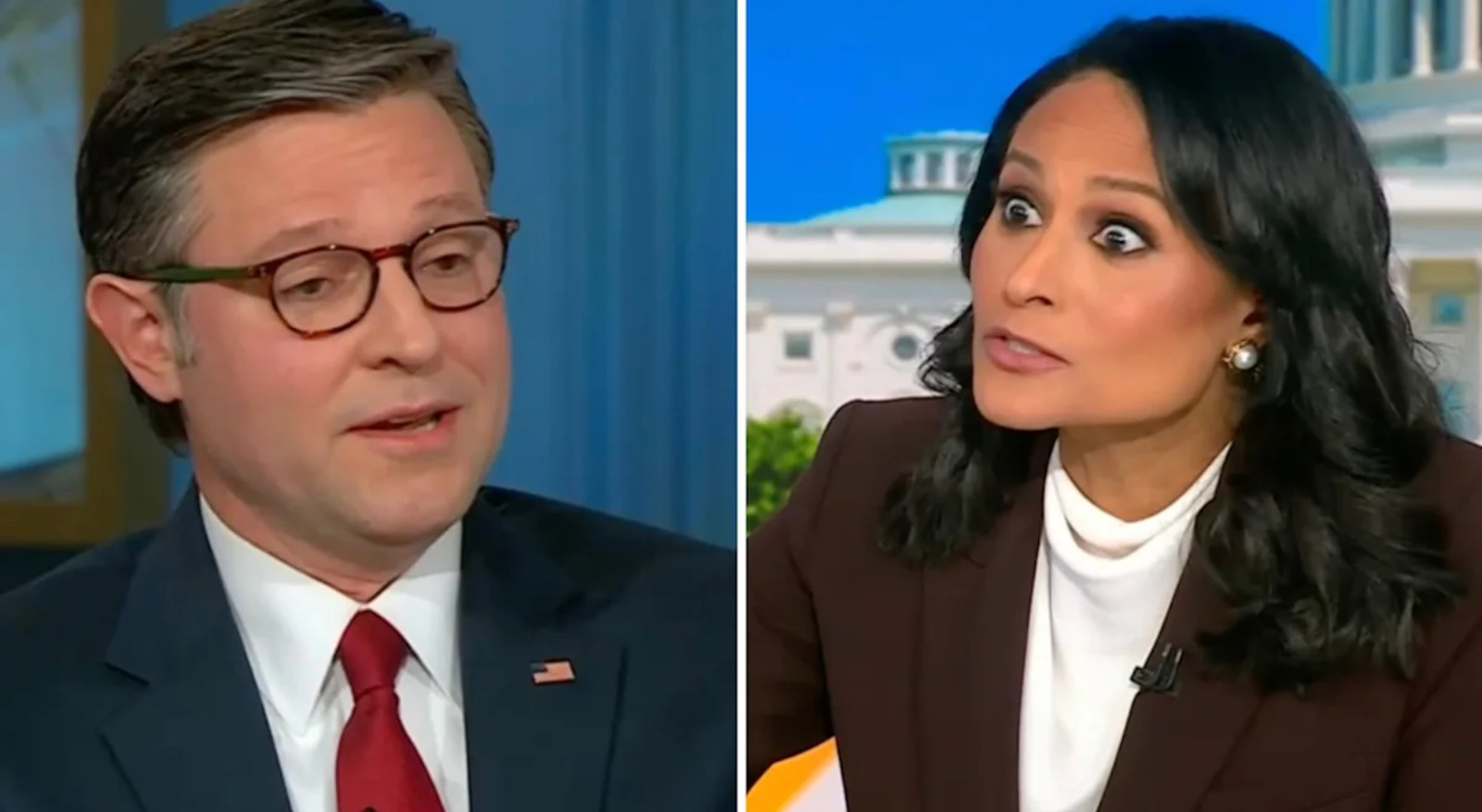
House Speaker Mike Johnson (R-La.) stated on Sunday that he supports certain federal immigration enforcement reforms that are also backed by Democrats. Johnson said a vote to end the shutdown on Monday will start with procedural votes in the late afternoon.
“Some of these conditions and requests that they’ve made are obviously reasonable and should happen. But others are going to require a lot more negotiation,” Johnson told host Kristen Welker on NBC’s “Meet the Press.”
Democratic leaders in both chambers of Congress are proposing changes to the operations of Immigration and Customs Enforcement (ICE) and Customs and Border Protection (CBP) personnel. This comes after the Senate passed a $1.2 trillion funding package on Friday, which includes five regular appropriations bills and a two-week stopgap measure for the Department of Homeland Security (DHS), the department that supervises ICE and CBP, The Hill reported.
On Friday, the House was in recess, resulting in funding for 78 percent of the federal government lapsing at midnight on Saturday. The ongoing stalemate is expected to last at least until Tuesday, as House Democrats have not agreed to expedite the approval of the funding package.
On Wednesday, Senate Democratic Leader Chuck Schumer (N.Y.) proposed several measures, including prohibiting roving federal immigration enforcement patrols, expanding warrant requirements for federal law enforcement, establishing a universal code of conduct for federal officers, and banning officers from wearing masks during operations.
“These are commonsense reforms,” Schumer said. “If Republicans refuse to support them, they are choosing chaos over order, plain and simple.”
Schumer did not, however, address Democratic lawmakers’ gaslighting of ICE and Border Patrol agents, claiming they were akin to “Nazis” and “Gestapo” with some labeling them “Trump’s secret police.” He also did not address the party’s efforts to whip up opposition to immigration enforcement efforts around the country.
Johnson expressed his support for banning roving patrols and requiring federal immigration officers to wear body cameras. But the Speaker said that officers wear masks “to protect their own identities and protect their own families” and argued that expanding warrant requirements would add a “whole other layer of, effectively, bureaucracy” for immigration enforcement.
“I really hope that everybody will come to the table in good faith,” he noted on the DHS negotiations. “That’s what’s going to be required here.”
A federal judge on Saturday declined Minnesota’s bid to temporarily stop the Trump administration’s large-scale immigration enforcement operation in the state, rejecting the request for an immediate pause as the lawsuit moves forward.
Minnesota, along with the cities of Minneapolis and St. Paul, filed the lawsuit in federal court, seeking a preliminary injunction to halt Operation Metro Surge, the Trump administration’s deployment of thousands of immigration agents to the Twin Cities region. State officials argued the surge exceeded federal authority and violated state sovereignty, particularly after the controversial deaths of two individuals during enforcement actions.
U.S. District Judge Kate Menendez, a Biden appointee, ruled that the plaintiffs did not meet the high legal standard required to freeze the operation, saying they failed to show they were likely to succeed on the merits of their constitutional claims.
The judge noted in her written decision that the state’s arguments were insufficient to warrant the extraordinary relief of a preliminary injunction while the case continues.
“Plaintiffs ask the Court to extend existing precedent to a new context where its application is less direct — namely, to an unprecedented deployment of armed federal immigration officers to aggressively enforce immigration statutes,” Menendez wrote.
“None of the cases on which they rely have even come close,” the judge added.
In her ruling, Menendez also acknowledged the significant impacts the surge has had on communities, including incidents that have drawn widespread public attention, but she emphasized that the court was not making a final determination on the legality of the operation itself.
Minnesota officials, including Attorney General Keith Ellison and Minneapolis Mayor Jacob Frey, expressed disappointment in the decision and signaled plans to continue pursuing the lawsuit.