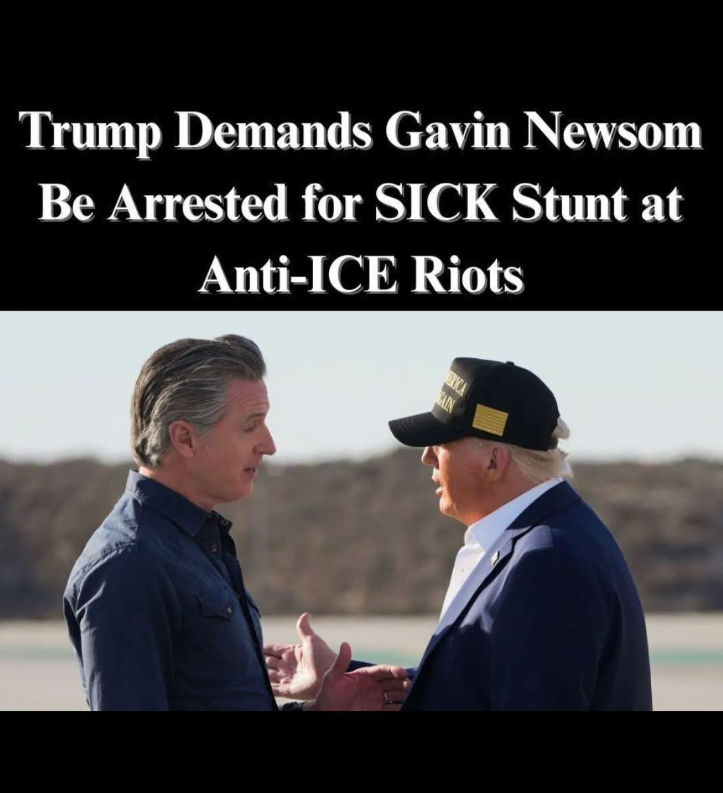
President Donald Trump ignited a political firestorm Monday after suggesting that California Governor Gavin Newsom should be arrested amid escalating anti-ICE riots in Los Angeles — a remark that underscores just how badly the situation in America’s largest blue-state cities has deteriorated.
The comment came during a brief exchange with reporters outside the White House, where Trump was asked about growing unrest in Los Angeles following a series of Immigration and Customs Enforcement (ICE) operations. Demonstrators have flooded city streets, harassing federal agents, blocking vehicles, and in some cases engaging in outright violence.
Fox News White House correspondent Peter Doocy put the question bluntly: Newsom has dared Trump’s border czar, Tom Homan, to arrest him. Should Homan take him up on it?
Trump didn’t hesitate.
“I would do it if I were Tom. I think it’s great,” Trump said. “Gavin likes the publicity. I like Gavin Newsom — he’s a nice guy — but he’s grossly incompetent. Everybody knows that.”
The president then delivered a familiar jab at Newsom’s governing record, pointing to California’s chronically delayed and massively over-budget high-speed rail project.
“All you have to do is look at the little railroad he’s building. It’s about 100 times over budget,” Trump added.
Riots, Not Protests
Trump went further, rejecting the framing pushed by Democratic officials and much of the media that the chaos in Los Angeles is merely “peaceful protest.”
“The people that are causing the problem are professional agitators,” Trump said. “They’re insurrectionists. They’re bad people. They should be in jail.”
The president’s language marks a deliberate escalation — not just rhetorically, but politically. By labeling the rioters “insurrectionists,” Trump is signaling that the federal government may treat these disturbances not as routine civil disobedience, but as organized resistance to federal law enforcement.
And the scenes unfolding in Los Angeles have made that argument easier to sell.
Video footage circulating online shows ICE agents being surrounded, insulted, and spit on. Vehicles have been blocked. Federal buildings vandalized. Local police, hamstrung by city leadership, appear reluctant to intervene decisively.
National Guard Deployed as State Leadership Falters
The situation deteriorated to the point that Trump authorized the deployment of at least 2,000 National Guard troops to Los Angeles over the weekend — a move that sent shockwaves through California’s political establishment.
Governor Newsom and Los Angeles Mayor Karen Bass quickly condemned the deployment, accusing Trump of “provocation” and “militarization.” But the administration countered that California’s leaders had failed to protect federal officers and uphold basic law and order.
Trump doubled down on that point during remarks later in the day.
“If you spit on police officers, there are going to be consequences,” he said, warning protesters that federal tolerance for attacks on law enforcement has ended.
The president made those comments while traveling alongside Secretary of State Marco Rubio, underscoring that immigration enforcement — and the backlash against it — has become a top-tier national security issue, not just a domestic political dispute.
Newsom’s Dare Backfires
Newsom’s decision to publicly taunt federal officials may have been intended as a political stunt, but it has increasingly looked like a miscalculation.
By daring Tom Homan to arrest him, the governor positioned himself not merely as a critic of ICE policy, but as a potential obstacle to federal law enforcement — a line that carries serious legal and constitutional implications.
While no serious legal analyst expects a sitting governor to be arrested imminently, Trump’s response sends a clear message: state officials do not get immunity if they actively obstruct federal law.
That message resonates with Trump’s base and with many Americans outside California who are watching blue-state leaders appear to side with rioters over officers.
A Broader Strategy Shift
Trump’s comments are not happening in isolation. They come amid a broader shift in the administration’s posture toward immigration enforcement and domestic unrest.
In recent weeks, the White House has:
- Expanded ICE workplace raids
- Accelerated deportation proceedings
- Increased cooperation between federal agencies
- Reduced tolerance for state and local interference
The administration has also made clear that it views sanctuary policies not merely as political disagreements, but as operational threats to federal authority.
From Trump’s perspective, Newsom’s posture fits a pattern: Democratic governors who loudly oppose enforcement, then act shocked when chaos follows.
Democrats Cry “Authoritarianism”
Predictably, Democratic lawmakers and activist groups reacted with outrage, accusing Trump of authoritarian rhetoric and abuse of power. Newsom allies claimed the president was “threatening democracy” and “criminalizing dissent.”
But that framing glosses over a crucial distinction Trump has repeatedly emphasized: dissent is not the same as disorder.
The administration insists it is not targeting peaceful protestors — but those who assault officers, obstruct operations, or incite violence.
And polling suggests the public is increasingly receptive to that distinction. Recent surveys show growing support for tougher responses to riots, especially when federal agents are targeted.
California as a National Warning
For Trump, California has become the cautionary tale.
Once a symbol of prosperity and innovation, the state now struggles with:
- Mass homelessness
- Soaring crime
- Crumbling infrastructure
- Exploding budgets
- Chronic governance failures
Trump’s critique of Newsom taps into a broader narrative: that Democratic leadership produces chaos, then deflects blame while demanding federal restraint.
In that sense, the president’s remark about arresting Newsom was less about legal reality and more about political symbolism — drawing a sharp contrast between enforcement and indulgence, authority and abdication.
What Happens Next
No arrest is imminent. But the standoff between the White House and California leadership is far from over.
Federal agencies remain deployed. National Guard troops are on the ground. ICE operations are continuing. And Trump has shown no sign of backing down.
If unrest continues — or escalates — pressure will mount for even stronger federal intervention.
And Gavin Newsom’s dare may come back to haunt him, not in handcuffs, but at the ballot box — as Trump and his allies frame California’s chaos as the inevitable result of Democratic governance.
One thing is certain: the immigration fight is no longer theoretical. It’s happening in real time, in America’s biggest cities — and the political consequences are only beginning.